
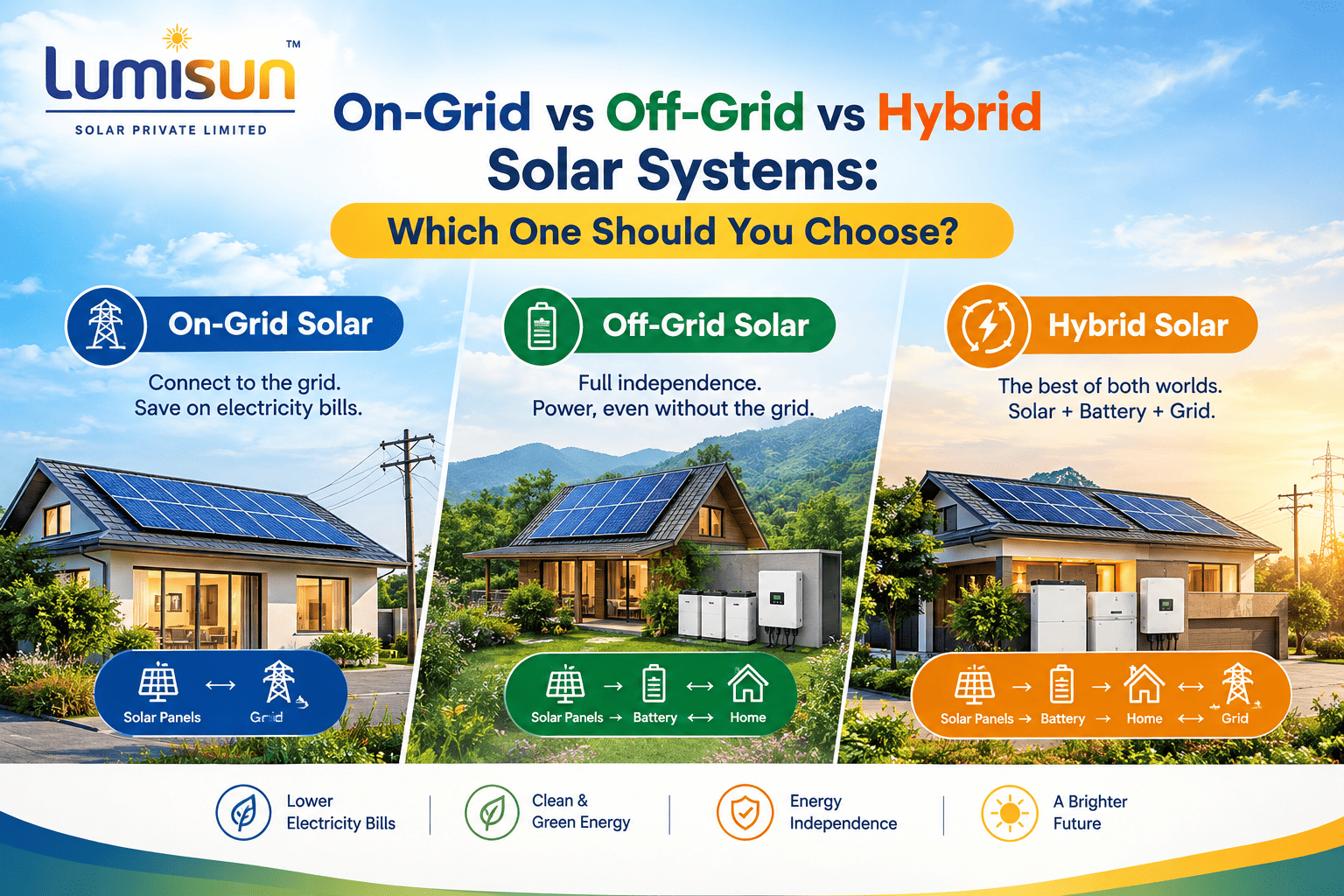
If you’ve looked into installing solar panels, you’ve probably come across these three terms: on-grid, off-grid, and hybrid. But do you really know what they mean? The difference sounds small, but it decides your monthly savings, how you’re affected during a power cut, and how much you spend upfront.
In this blog, you’ll read about what each of these three terms means and which one is the best fit for you.
What Do These Three Systems Actually Mean?
On-Grid Solar System
An on-grid solar system is connected to the electricity grid at all times. When the panels are on your roof, they generate electricity during the day and you use it directly. Any extra electricity is sent back to the grid through a facility called net metering. At night or on cloudy days, you draw that credited electricity back from the grid.
Off-Grid Solar System
An off-grid solar system cuts the cord entirely. There’s no grid connection at all — every unit of electricity you use comes from panels and a battery bank. This setup is built for locations where grid access is unreliable or completely absent, and it depends heavily on batteries sized correctly for daily use.
Hybrid Solar System
A hybrid solar system is the middle path. It stays connected to the grid like an on-grid setup, but also includes a battery, much like an off-grid one. So you get net metering benefits during the day and automatic battery backup the moment the grid fails.
Cost, Backup and Maintenance — Quick Comparison
| Upfront Cost | Backup & Maintenance | |
| On-grid | Lowest — no battery to buy or maintain | No backup during outage; needs only occasional cleaning |
| Hybrid | Mid-to-high, depending on battery capacity chosen | Automatic backup; battery needs periodic checking |
| Off-grid | Highest — driven by the battery bank required | Full backup; battery needs periodic checking |
Bill savings: on-grid and hybrid both have net metering. Extra units of electricity get credited back through the utility.
Which System Suits Homes in Telangana and Andhra Pradesh?
If you rarely face power cuts
Most cities in Telangana and Andhra Pradesh get reliable electricity with few outages. For these areas, an on-grid system works best — you skip the cost of batteries and maximise your savings through net metering.
If you face frequent or long outages
If you live on the outskirts of a city, on a farmhouse, or run an industrial shed, you might face longer and unpredictable power cuts. In these cases, a hybrid solar system is the best option — it keeps essentials like fans, lights and Wi-Fi running without waiting for the grid to return.
If you’re completely off the grid
For a farm far from any city or town, or a plot with no electricity grid nearby, an off-grid system is the right choice — there’s simply no utility connection to rely on in the first place.
Pros and Cons
| Solar System | Pros | Cons |
| On-grid | Lowest cost, fastest payback through net metering | No backup during a grid outage |
| Hybrid | Backup power plus net-metering savings together | Mid-to-high upfront cost between on-grid and off-grid, plus battery maintenance |
| Off-grid | Full independence from the grid | Highest upfront cost of the three, with no net-metering savings |
FAQs
A. If your area sees frequent outages, yes — most homeowners find the added battery cost pays for itself in convenience alone, aside from the savings on bills.
A. In many cases, yes, provided the inverter supports it. It’s a common upgrade path once budgets allow.
A. Good quality lithium batteries used in hybrid or off-grid setups usually last 8–10 years with proper care, though this varies by usage and brand.
Conclusion
Choosing between an on-grid, off-grid, or hybrid solar system really comes down to how reliable your power supply already is and how much backup you actually need. On-grid works best where cuts are rare and savings matter most, off-grid is built for places with no grid access at all, and a hybrid solar system offers the best of both when outages are frequent but you still want the benefits of net metering.